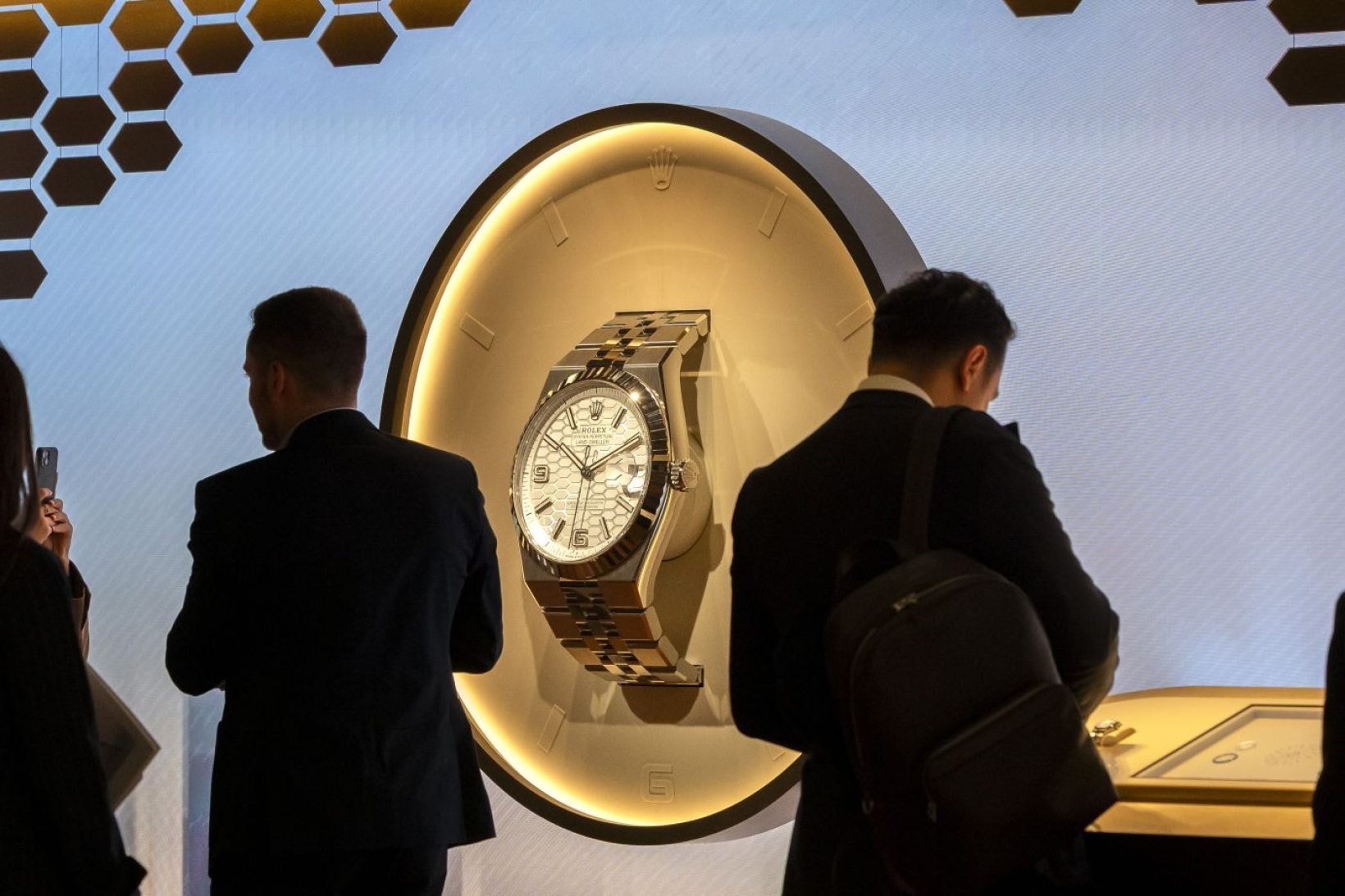
While the truce in the Middle East has temporarily eased concerns, it has not alleviated the multifactorial crisis that has been affecting the watchmaking sector for nearly two years. As Watches and Wonders Geneva opens its doors on April 14, and as new geopolitical challenges destabilize the industry, what prospects are emerging for watchmakers and subcontractors in 2026?
In the United Arab Emirates, particularly in Dubai, tourism has come to a standstill, and exports by companies based in the region have been severely hampered since the start of the conflict between the United States, Iran, and Israel (Shutterstock)
30%
Drop in watches orders from suppliers in the first trimester of 2026
5%
Share of the Middle Eastern market in global luxury sales
45%
Decline in watch sales volumes since the 2010s
The war in the Middle East will lead to higher inflation and slower global growth, even if the conflict were to end immediately
Kristalina Georgieva, IMF Managing Director
The rise in global uncertainty since the beginning of the Middle East conflict has exacerbated the tensions already undermining the watch sector. Already weakened by conflicting announcements regarding U.S. tariffs a year ago, the industry is now experiencing a sharp drop in demand across markets in recent weeks. The growing caution among watch enthusiasts, prompting them to postpone purchases, is now reflected in brands’ first-quarter results. In Switzerland, the strong franc is a significant deterrent for tourists looking to purchase watches locally. Market executives, speaking anonymously, confirm a pronounced slowdown, with figures at their lowest levels.
Newsletters
Cet article vous plaît ?
Inscrivez-vous à nos newsletters pour recevoir les dernières publications et analyses selon nos 4 thématiques:
NewsGen ZAnalysesTrends to watch
The Middle East Conflict as a Revealing Factor
The war involving the United States, Iran, and Israel has further reinforced the Swiss franc’s status as a safe haven (at 0.79 against the dollar). Internationally, the conflict—disrupting air traffic to Asia via Gulf hubs and maritime routes through the Strait of Hormuz—has had a lasting impact on trade, exports, and energy resources. “The war in the Middle East will lead to higher inflation and slower global growth, even if the conflict were to end immediately,” said IMF Managing Director Kristalina Georgieva to Reuters on Monday, April 6.
The luxury sector—and the watch industry in particular—is experiencing a shift toward normalization following several years of overconsumption, especially in the soft luxury segment (Shutterstock)
Commenting on the consequences of the conflict for the luxury industry, Arthur Jurus, Chief Investment Officer at ODDO BHF Switzerland, explains: “The Middle East conflict is acting more as a revealing factor than a trigger of the current weakness in the luxury sector. The direct impact remains limited but tangible: growth forecasts have been slightly revised downward for the first half of 2026, with an expected contraction in the region due to declining tourism and local consumption. This disruption is nevertheless perceived as temporary and does not, at this stage, alter the annual outlook. However, it amplifies a key element: rising uncertainty and perceived risk, which is already leading to multiple compression.”
The direct impact of the Middle-East crisis remains limited but tangible: growth forecasts have been slightly revised downward for the first half of 2026
Arthur Jurus, Chief Investment Officer at ODDO BHF Switzerland
In the United Arab Emirates, particularly in Dubai and Abu Dhabi, tourism has come to a standstill, and exports from companies based in the region are heavily disrupted. Hotels are reporting extremely low occupancy rates, ranging between 5% and 10%, and the restaurant sector is severely affected. For reference, the Middle East accounts for between 5% and 6% of global luxury sales, with the UAE representing around half of regional revenues. Since February 28, boutiques that briefly closed at the beginning of the conflict have been reporting double-digit declines. The high-end automotive sector is also impacted. Chris Bull, director of the F1rst Motors showroom in Dubai, confirmed a 30% drop in revenue in March to Reuters.
However, more broadly, the sector’s real challenge is not cyclical but structural. Luxury—and watchmaking even more so—is now undergoing a normalization phase after several years of overconsumption, particularly in the soft luxury segment. “In this context,” continues Arthur Jurus, “residual growth is primarily coming from the very high-end and jewelry segments, confirming a polarization of the market toward the wealthiest clients. The geopolitical conflict merely amplifies this trend by further weakening the middle-tier clientele and tourism flows.”
The watchmaking sector, highly sensitive to global macroeconomic balances, remains dependent on affluent clients. Since January 2026, global watchmaking has shown limited and uneven growth. Swiss exports fell by 3.6% in January (CHF 1.92 billion), then rebounded by 9.2% in February (CHF 2.17 billion), resulting in a 2.8% year-on-year increase. The United States and Japan are driving growth, while China and Hong Kong remain fragile. The high-end segment is holding up better, but as of April 8 (at the time of writing), the market remains highly polarized.
A 2-year Long Ongoing Crisis in the Watchmaking Industry With Significant Impact
For the past two years, the watch industry has been experiencing its longest uninterrupted crisis in forty years (Shutterstock)
We are selling fewer watches at higher prices. Since 2000, the average price has more than quintupled, while volumes have split in half
Olivier R. Müller, founder of LuxeConsult
Beyond economists’ figures and the geopolitical shock, subcontractors are the true barometer of the sector’s health. A watch industry specialist with over 25 years of experience, speaking anonymously, shared the following insights: “Overall, suppliers are very concerned, but to varying degrees, depending mainly on the nature of their clients and how they have adapted to the industry’s structural changes since the 2010s. For 15 years, watchmaking volumes have declined by 45%, while value has doubled. Suppliers have been receiving smaller but higher-value orders. Today, most of them have been struggling since 2024, when the market began normalizing after the post-Covid boom. Those who are not fortunate enough to work with brands such as Rolex, Patek Philippe, or Audemars Piguet—who provide continuity and volume—are suffering from the slowdown, and conditions are becoming increasingly difficult.”
For the past two years, watchmaking has been experiencing its longest uninterrupted crisis in forty years. Primarily affected by the weak recovery in Asia and growing consumer fatigue toward luxury—driven by prices perceived as too high and disconnected from intrinsic value—the industry has shifted toward “premiumization,” focusing almost exclusively on the wealthiest clients, who are more resilient to economic shocks. As a result, the long-term decline in watch production is structurally transforming the Swiss watch industry, weakening its industrial base, which historically relied on high production volumes. Olivier R. Müller, founder of LuxeConsult, states: “Watchmaking will continue along this downward trend; this is not a temporary phenomenon. In 2025, 14.7 million watches were exported. I believe we will see a further decline in 2026, with exports likely around 14.3 million. It’s a fact: the market is premiumizing. We are selling fewer watches at higher prices. Since 2000, the average price has more than quintupled, while volumes have split in half.”
Leading brands will keep the market tight by reducing volumes by 2% to 3% each year, as they typically do
Olivier R. Müller, founder of LuxeConsult
What is the actual decline experienced by subcontractors, who are directly exposed to brands’ real order flows? The industry expert continues: “Suppliers working with top five brands are seeing declines of around -5% or are stable. For others, the drop is closer to -30% this year. This must be understood in light of the so-called ‘bullwhip’ on inventories. When the market overheats—as it did during the post-Covid revenge buying phase—many brands lose control of their supply chains. One watch sold at a distributor leads to two ordered within the market, four ordered from the manufacturer, eight produced at the factory, and ultimately sixteen made by suppliers. When the market slows, this creates massive excess inventory. Some brands now have between three and five years of stock. As a result, they reduce production and stop ordering from suppliers. Currently, this lag is estimated at between 24 and 36 months. Very high-end brands are less affected.”
Employment Under Pressure
Sur les 2000 à 3000 emplois créés à la suite de l’embellie post-Covid, beaucoup sont en trop aujourd’hui dans le secteur horloger (Watches And Wonders 2024)
Of the 2,000-3,000 jobs created to meet demand, many are now excess
A watch industry expert
Following the post-Covid boom, manufacturers and subcontractors invested heavily in additional production capacity, increasing capital expenditures. Today, underutilized, these investments are weighing heavily on balance sheets. The expert adds: “Of the 2,000-3,000 jobs created to meet demand, many are now excess. Temporary contracts have not been reconducted while reduced working hours have been widely used, the industry is now moving toward layoffs—but discreetly. We are seeing what could be described as ‘drip layoffs,’ kept just below the thresholds that would trigger formal redundancy plans.”
Some signs of recovery are beginning to emerge. However, the inertia from the past two years and the geopolitical shock linked to the Middle East conflict mean that, in 2026, brands will be very cautious about investments and scenarios. “I expect we will not see many major innovations from most brands. In times of growth, brands focus on expanding offerings and enriching collections; in times of crisis, they focus on optimization—producing at the best cost for high perceived value.”
What strategies will watch brands adopt in 2026? Olivier R. Müller concludes: “Seeking growth is difficult. Leading brands will remain cautious on volumes and aim for marginal value growth, mainly through price increases resulting from the strength of the Swiss franc. They will keep the market tight by reducing volumes by 2% to 3% each year, as they typically do.”
In 2026, the brands that will perform best are those that have achieved a clear product offering, well-managed inventories, investment levels aligned with production, and balanced distribution strategies.
As every year, the grand watchmaking salon will open its doors at Palexpo in Geneva from April 14 to 20, featuring many new developments. Eleven brands will be making their debut, including Audemars Piguet, which will be making a grand return, while in the city center, a new venue will host the Montreux Jazz Festival for the very first time.