With the publication of the “2025 Sustainability Report”, Audemars Piguet has clearly set out its sustainability objectives, which the brand has supported with several commitments, including the phasing out of ruby sourcing and the allocation of 2% of its turnover to its two Foundations. Luxury Tribune was able to conduct an exclusive on-camera interview with Ilaria Resta, the brand’s CEO, about these developments.
Ilaria Resta, pictured above, has been CEO of Audemars Piguet since January 2024 (Audemars Piguet)
91,074
AP’s total CO₂ emissions for 2025
7%
Reduction in AP’s CO₂ emissions compared to 2024
75+
Number of suppliers that have signed the Swiss Triple Impact (STI)
We believe it is our responsibility to be transparent, because this openness leads us to be accountable for our actions […] and to commit to ever more ambitious goals
Ilaria Resta, CEO of Audemars Piguet
Recent climate events – the severity of whose impact on nature and people around the globe has never been so intense – seem to have served as a stark wake-up call. Whilst the most polluting industries, including fashion, struggle to communicate transparently, others are beginning to realise that opening up their manufacturing processes – and indeed the entire value chain – is non-negotiable.
Ilaria Resta has made the sourcing and traceability of gemstones a priority for Audemars Piguet, conducting visits to mines to ensure compliance with safety, ethical, and human rights standards (Audemars Piguet)
For the high-end watch industry, which prides itself on timelessness, rarity and heritage, the challenge now is to prove that transparency does not stop at the finished product, but encompasses all stakeholders, right down to the sourcing of raw materials.
Reporting on environmental, social, human rights and governance issues has become a requirement for large public-interest companies, particularly listed firms. In Switzerland, publishing an annual report on non-financial matters when they exceed the specified thresholds has been mandatory since 2023, with climate reporting added to this requirement from 2024 onwards. As such, listed luxury groups are obliged to comply. However, other powerful players in the watch industry, which are not listed on the stock exchange, are following on a voluntary basis.
This is the case with Audemars Piguet, which is publishing its second Sustainability Report this July. This initiative is supported by several commitments that demonstrate a desire for more transparency.
Commitments That Have Long Remained Largely Out of The Spotlight
We are very proud to have succeeded in reducing our emissions by 7 per cent in 2025, as this is a collective effort, carried out with our suppliers and the entire value chain
Ilaria Resta, CEO of Audemars Piguet
Audemars Piguet CEO Ilaria Resta, speaks on camera for the first time about the brand’s commitments – which have long remained largely out of the spotlight due to a desire for discretion. Today, the mindsets have changed and the public’s demand for transparency is growing. Ilaria Resta explains: “We believe it is our responsibility to be transparent, because this openness leads us to be accountable for our actions […] and to commit to ever more ambitious goals.”
Several aspects are innovative. Beyond the climate targets validated by the SBTi (Science Based Targets initiative), the structuring of its supply chain and its social progress, the brand stands out with a significant financial commitment: the formal allocation of 2 per cent of its annual turnover to the Audemars Piguet Foundations (the Audemars Piguet Foundation for Trees, established in 1992, and the Audemars Piguet Foundation for the Common Good, founded in 2023). This approach gives real economic substance to sustainability: “The more we grow, the more we are able to give back,” adds Ilaria Resta.
On January 22, Audemars Piguet unveiled its new manufacturing facility in Le Brassus, named “L’Arc,” which is equipped with state-of-the-art technology designed to optimize production processes and address energy and environmental challenges (Audemars Piguet)
To achieve its ambitions, Audemars Piguet relies on a framework known as the “3/6 Sustainability Framework”, structured around three pillars: the environment, people and communities, and governance; as well as six priorities: climate change, raw materials, employees, watchmaking expertise, communities and business ethics. This framework is underpinned by a 2025–2030 roadmap, which aims to translate commitments into measurable targets and governance mechanisms.
With regard to emissions, the main climate challenge lies beyond the factory walls: “Our total market-related emissions for 2025 stood at 91,074 tCO₂e, representing a reduction of around 7 per cent compared with 2024. Scope 3 emissions accounted for 98 per cent of our carbon footprint, which confirms the importance of addressing upstream activities and working closely with our suppliers, logistics partners and service providers,” the report states. On this point, Ilaria Resta adds: “We are very proud to have succeeded in reducing our emissions by 7 per cent in 2025, as this is a collective effort, carried out with our suppliers and the entire value chain.”
Helping Suppliers Who Lack The Capacity to Comply
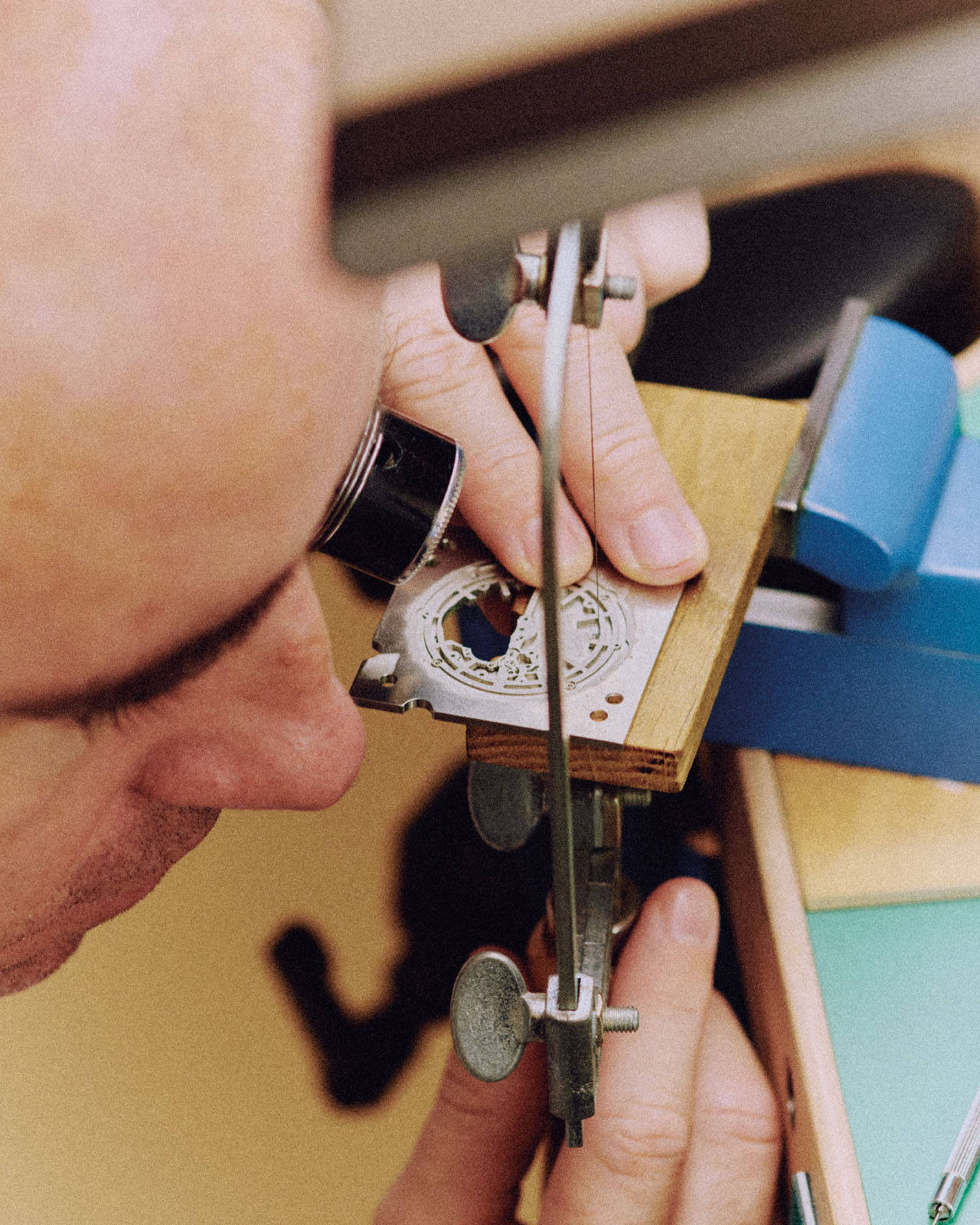
Unveiled at Watches and Wonders Geneva, Audemars Piguet’s “Atelier des Établisseurs” project has brought the “établissage” tradition back into the spotlight—a historic collaborative method in Swiss watchmaking that brings together independent workshops under the leadership of an “établisseur” watchmaker (Audemars Piguet)
However, these suppliers, already struggling due to the sector’s economic difficulties, often lack the financial resources or in-house expertise to adapt. When asked about this, the CEO was keen to point out that efforts to persuade suppliers to comply with the standards are very often supported by assistance: “Today, more than 75 suppliers have signed up to the Swiss Triple Impact (STI).”
One of the major, high-impact decisions we have taken is to stop sourcing rubies. The reason? We could not find any mines that met our ethical and human rights standards
Ilaria Resta, CEO of Audemars Piguet
Another revelation that stands out in the watch industry is the decision to stop sourcing rubies – a first for the sector. Ilaria Resta explains: “We are working to strengthen control over the sourcing and traceability of precious stones. We visit the sites and mines to check whether safety, ethical working practices and respect for human rights are actually being upheld. When we find that any of these aspects are lacking, we take action. One of the major, high-impact decisions we have taken is to stop sourcing rubies. The reason? We could not find any mines that met our ethical and human rights standards. (…) We want to go out into the field ourselves, as part of a thorough verification process, to check whether the images we receive accurately reflect reality.”
With this report, Audemars Piguet clearly sets out its sustainability strategy. The company highlights scientifically validated climate targets, more structured governance, greater focus on suppliers and raw materials, as well as a broader vision of sustainability, including the transmission of savoir-faire. For the privately-owned, family-run Manufacture, the challenge is clear: to move from a culture of discretion to one of greater transparency.
Through its sustainability report, Audemars Piguet highlights scientifically validated climate goals, more structured governance, and a greater focus on suppliers and raw materials (Audemars Piguet)
At the head of Audemars Piguet since 2024, Ilaria Resta is accelerating the transformation of the family-owned brand. Between financial structuring, broader outreach to the general public, and investment in innovation, she explains the strategic vision for 2040 designed to secure growth.
On 22 January, Audemars Piguet unveiled its new Manufacture in Le Brassus, named L’Arc, equipped with the latest technological infrastructure to optimise its production flows and meet energy and environmental challenges. It also unveiled its ‘Fab Labs’, units dedicated to innovation.