Watches
Cartier celebrates the tenth anniversary of its Maison des Métiers d’Art
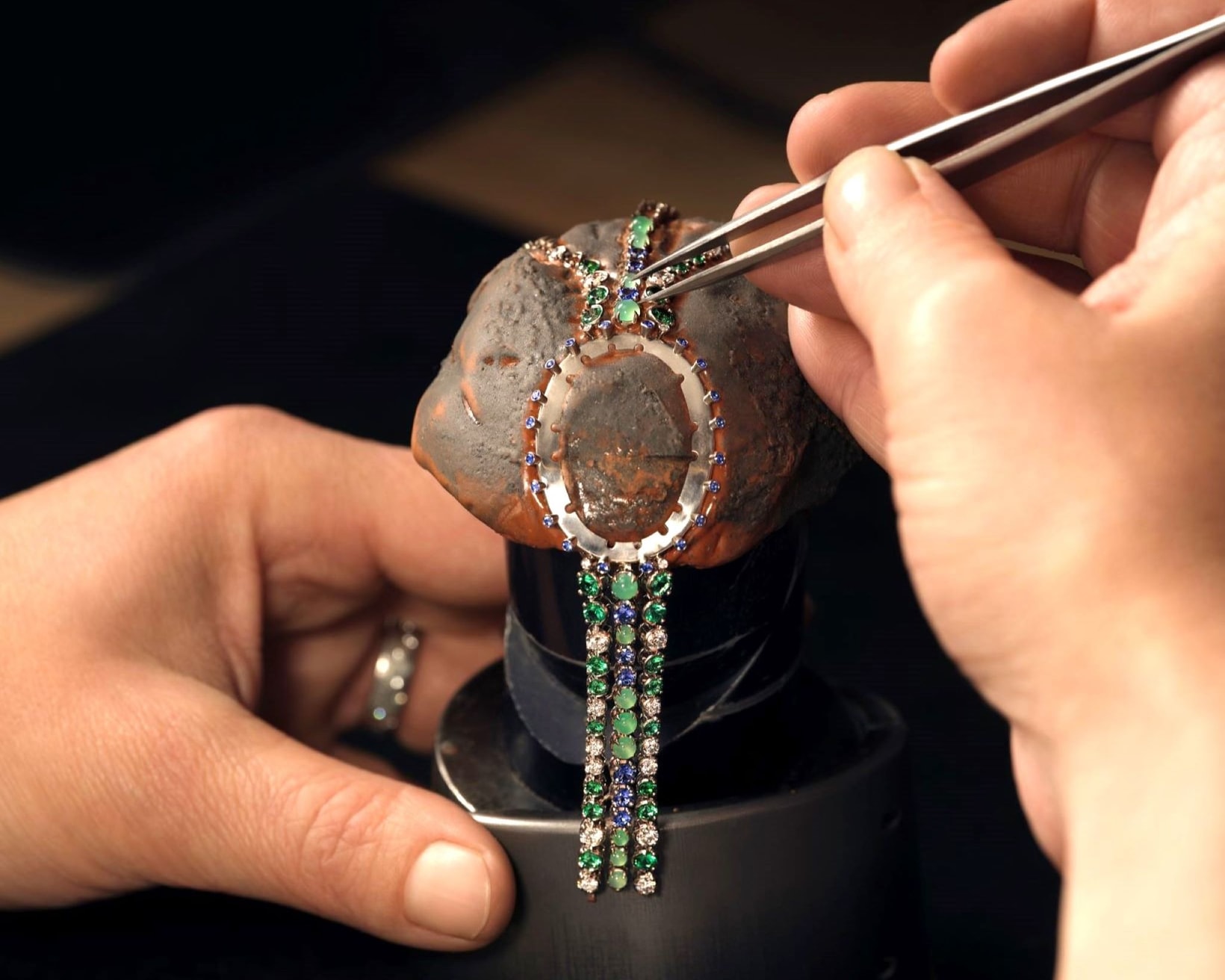
Preserving, innovating and transmitting are the three key missions of the Maison des Métiers d'Art Cartier, located in La Chaux-de-Fonds, close to the watchmaking factory in the canton of Neuchâtel. This Wednesday, November 6, Cartier has chosen to celebrate the tenth anniversary of this place of tradition in Geneva, on the shores of Lake Geneva, in its emblematic boutique.
According to Cartier, a “métier d'art” is characterized by “a rare, exceptional know-how born of tradition. These manual crafts, often handed down from generation to generation, require years of practice to master the gesture”. In 1847,
Cartier's history began with jewelry, followed by watchmaking in 1853. These two worlds, pillars of the maison Cartier, now work in synergy from the Maison des Métiers d'Art. In a 17th-century Bernese-style farmhouse, where the woodwork, stone floor and fireplace are typical of the region, some fifty employees develop and produce prestigious watch collections.
“The spirit of this place is unique: to preserve and transmit métiers d'art that are often forgotten or rarely practiced, in a dynamic where innovation has its rightful place and feeds the unlimited creativity of the maison. We are convinced that it is this dialogue between tradition and modernity that will enable métiers d'art to survive time and remain a heritage that is more alive than ever”, said Karim Drici, Cartier's Industrial Director, in a press release.
Three main families currently constitute Cartier's métiers d'art. The art of composition, i.e. the art of assembling various materials such as wood, straw or rose petals, in the space of a watch dial. For example, on the round Louis Cartier Eclats de Panthère watch (2022), the artisan marqueur - whom we met in the Geneva boutique on Wednesday - assembled 124 fragments of straw, wood, crystal, sapphire, gold and mother-of-pearl on a metal plate.
The art of fire refers to all the techniques involved in working with enamel, as in the Crash Tigrée watch (2022). Enameling requires more than ten kiln passages, between 750°C and 700°C, depending on the desired color. Finally, the art of metal combines two techniques: granulation, Cartier's traditional know-how since 2013, and filigree, a goldsmithing technique that uses gold or silver wires fused together. The Louis Cartier Zèbre et Girafe (2022) round watch, for example, required the granulation of six gold alloys to evoke the giraffe through the characteristic detail of its spots.
In addition to preserving ancestral know-how, Cartier focuses on innovation to create its pieces, using 3D printing on gold, laser, microfluidics, mechanics and magnetism. In terms of transmission, the Maison des Métiers d'Art collaborates with various training establishments in Switzerland and
France, based on gem-setting, jewelry and watchmaking. In Couvet, Switzerland, the Institut Horlogerie Cartier (IHC) has been welcoming apprentices and craftsmen from the Cartier manufactures since 1993, with the aim of training them in the watchmaking and mechanical trades. Between 150 and 200 employees are trained there every year, and IHC trainees are continuously on board at the Maison des Métiers d'Art.
This year, Cartier also celebrated the 27th edition of its “Talents Horlogers de Demain” prize on the theme of “Magic of the Senses”, designed to reward young Swiss, French and German apprentice watchmakers. Candidates will work from a clock movement to explore, without constraint, all the aesthetic and creative territories linked to the theme. Six technicians and six apprentices were selected in mid-October to present their projects to a jury at the Maison des Métiers d'Art on December 16, after 80 hours of work spread over two months. The winners will be announced at the awards ceremony in mid-January 2025.