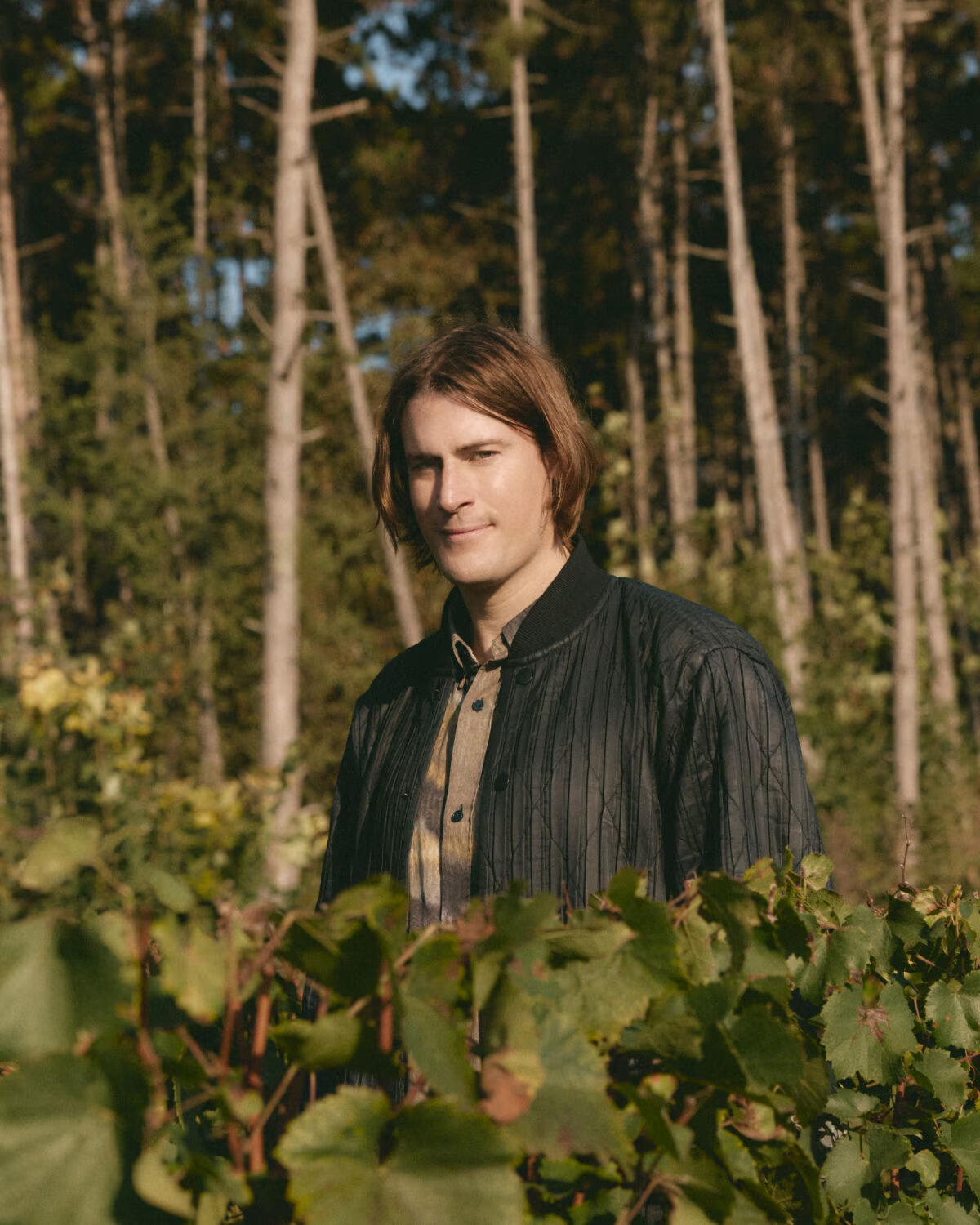
He is the Swiss artist on the rise. His work expresses ecological chaos through pieces that are both poetic and technological. This non-activist approach launched his international career and led to a fruitful collaboration with Ruinart in 2025.
The Olivier Varenne Gallery in Geneva is presenting the exhibition “Julian Charrière & Jannis Kounellis” through October 31 (DR)
Deep within Tasmania lies a strange machine. Beneath the Triassic sandstone of Australia’s largest island—where the underground and utterly bizarre Museum of New and Old Art (MONA) is partially hidden—Breathe restores the Earth’s primordial oxygen and gives visitors the opportunity to breathe this ancient air extracted from 2.8-billion-year-old iron oxide rock. “2.8 billion years ago marks the Great Oxidation Event,” explains Vaud-based artist Julian Charrière, creator of this complex installation, which he developed over three years in collaboration with scientists and chemical engineers. “It was this decisive moment in our planet’s history that established the conditions for life.” To fully appreciate this feat, the installation follows a specific ritual: the viewer enters alone into a sort of chapel to commune with the depths of time and experience the invisible substance of this immaterial sculpture.
Newsletters
Cet article vous plaît ?
Inscrivez-vous à nos newsletters pour recevoir les dernières publications et analyses selon nos 4 thématiques:
NewsGen ZAnalysesTrends to watch
An Interest in Technology and the Natural World
Swiss artist Julian Charrière stands in front of his work Breathe, on display at MONA in Tasmania (Mona/Jesse Hunniford/Courtesy of the artist and MONA)
[Jannis Kounellis] and I share this interest in matter viewed both as an archive and a memory, but also as something that has the potential to transform
Julian Charrière, artist
Because nature and its phenomena are his primary sources of inspiration, Julian Charrière has often been labeled an “ecological artist.” So yes, his work addresses the environment and its decline, but more through the technological poetics of his installations than through a fiercely militant consciousness. An interest in technology and the natural world also led him to enroll at the Haute école d’art de Sierre rather than ECAL, where the artistic curriculum is more deeply rooted in the modern pictorial tradition, before continuing his studies at the Berlin University of the Arts, within the Institut für Raumexperimente, founded in collaboration with the Danish artist Olafur Eliasson. “At the time, my favorite artists were mainly from the American Land Art movement. Even though my relationship with nature as an artist was completely different from that of Michael Heizer or Robert Smithson, who didn’t hesitate to move tons of rock with bulldozers or to carve enormous gashes into the desert,” explains Julian Charrière, who is currently exhibiting at the Olivier Varenne Gallery in Geneva and also serves as artistic director of MONA. Or rather, he is presenting his works in dialogue with those of Jannis Kounellis, a brilliant Arte Povera artist of the 1960s and 1970s, whose use of coal, steel, burlap, and even old bells in his work inevitably resonates with that of the artist from Vaud. “He and I share this interest in material seen both as an archive and a memory, but also as something that has the potential to transform. Still, the perspective of the Arte Povera artists centered on a certain idea of postwar modernity at a time when Europe was rebuilding itself. In that sense, our messages are quite different.”
Denouncing Through the Absurd
The heliographs Burn Sunshines Burn (2023) are displayed alongside two black pastels, Untitled (2008), by the Italian artist Jannis Kounellis (Galerie Olivier Varenne)
Right next to two black pastels, Untitled, by the Italian maestro from 2008—which likely depict pieces of coal by playing on positive and negative contrasts—Julian Charrière has hung Buried Sunshines Burn, two heliographs in which, behind their golden reflections, one can make out an abstract composition of somewhat soft forms. It is, in fact, an aerial view depicting the oil fields that surround Los Angeles. “A city built on oil, thanks to oil,” the artist explains. “Heliography is the first photographic process, invented by Nicéphore Niépce in 1827—well before Daguerre’s process in 1835—which uses a bitumen emulsion, a derivative of crude oil, to fix the image.” This is exactly the same process Julian Charrière used for these two pieces presented in Los Angeles, but he sourced California asphalt from natural deposits without relying on the extraction industry. It’s a way of utilizing the energy source that powers the world while simultaneously freezing it in its representation. “It’s a kind of reconciliation between the image and the substance it implies, without necessarily seeking to be critical,” the artist continues, standing before an old 19th-century clock studded with gypsum crystals.
By petrifying these 19th-century clocks, I reveal the construction of a cultural temporality that is now frozen in time, giving way to another process of time’s accumulation: a time related to geology and Earth systems
Julian Charrière, artist
Imperfect Lovers, 2026 (Olivier Varenne Gallery)
It belongs to a group of objects the artist has just exhibited at the Museo Correr in Venice alongside the sculptures of another Italian genius—this one a Neoclassicist: Antonio Canova. The concept? Abandoned for several years in a limestone cave, these fragile, gilded mechanical devices emerged transformed into mineral-like sea urchins. “By distancing us from the natural cycles that once dominated our conception of time—the seasons, day, and night—clocks have, in a sense, distorted our nature. They have imposed upon us the rhythm of work and production. Then came digital time, even less tangible. That is why, by petrifying these 19th-century clocks, I reveal this construction of a cultural temporality that is now frozen, giving way to another process of time accumulation: a time related to geology and Earth’s systems,” continues the artist, who has lived in Berlin for twenty years and whose career has taken off at a dazzling pace since his 2014 exhibition *Future Fossil Spaces* at the Cantonal Museum of Fine Arts in Lausanne, which accompanied the Manor Vaud Cultural Prize. “I was 27 years old and had 900 square meters of exhibition space to fill.” There, he presented installations that have become iconic in his body of work, such as the salt columns, the cryogenically frozen plants, and that video in which he attempts to melt the tip of an Icelandic iceberg he had climbed using a blowtorch.
Luxury Loves His Work
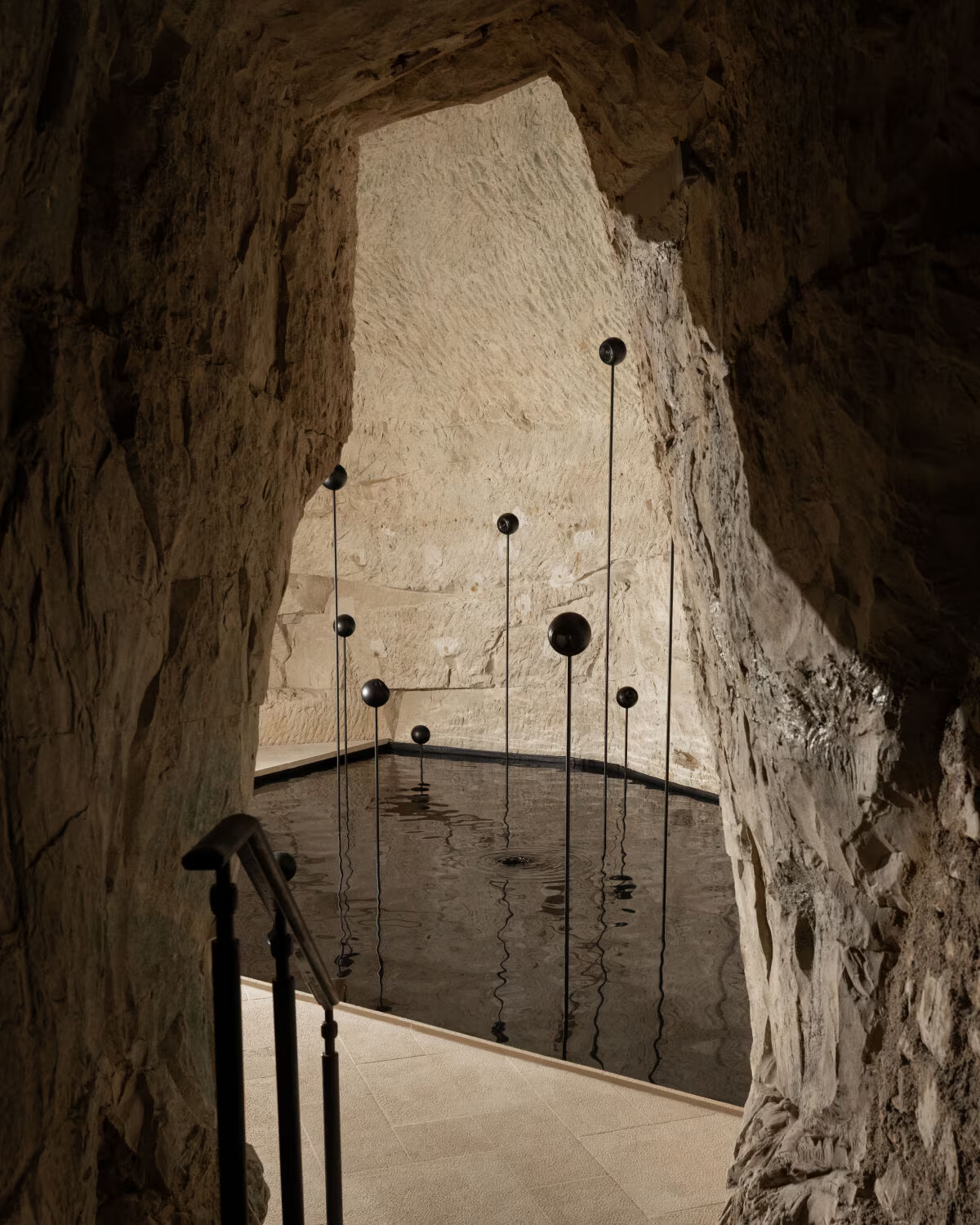
In 2025, Julian Charrière collaborated with Ruinart as part of “Conversations with Nature.” He created Chorals, a sensory installation in the estate’s cellars near Reims (Ruinart)
When I saw the [Ruinart] cellars, carved into the ancient chalk formations, I asked if I could use that space
Julian Charrière, artist
This kind of situation where the absurd lies as much in the scene itself as in our extraordinary ability to deny the climate crisis. The artist is currently in high demand in Switzerland (Kunsthaus Zurich, Tinguely Museum in Basel, MASI in Lugano, MCBA in Lausanne) and on the international scene. These invitations come from both institutions—after Beijing and Mexico, he is preparing for the Geffen Contemporary at MOCA in Los Angeles, where he will present, among other things, a book whose pages were made from dead coral—and luxury brands. “I don’t see the problem as long as the proposal is interesting and serves my work.”
Following artists Sam Falls and Lélia Demoisy, Julian Charrière collaborated on the “Conversations with Nature” series organized by the Ruinart champagne house. “It wasn’t about designing a bottle—which I would have refused—but about creating a permanent piece for the estate near Reims.” Initially, the installation was supposed to be outdoors. “But when I saw the cellars, carved into the ancient chalk formations, I asked if I could use that space.” Beneath the white chalk vaults, he conceived Chorals, a sensory installation that blends light, water, and sound—the rustling of reefs, clinking sounds, and the cries of marine life—reminding us that a warm sea once covered the Champagne region. “It’s a magnificent work of which I’m particularly proud,” explains Julian Charrière. “This kind of collaboration helps me manage my workload by allowing me to develop my future projects.”
Whether established or emerging, exhibiting at Art Basel can change not only an artist’s fate, but also that of a gallery. For its 56th edition, the world’s leading art fair continues to surprise with breathtaking installations, ranging from those by renowned Japanese visual artist Tadashi Kawamata (Ruinart Art Lounge) to the young Swiss painter Marius Steiger.
According to projections from UBS’s 2025 Global Wealth Report, more than $83 trillion is expected to change hands by 2045 in the Western world. An increasing share of this wealth will be controlled by women. The art market, which has always followed the flow of capital, is undergoing a major transformation. According to experts, women have a completely different approach to collecting. A profound shift is underway.