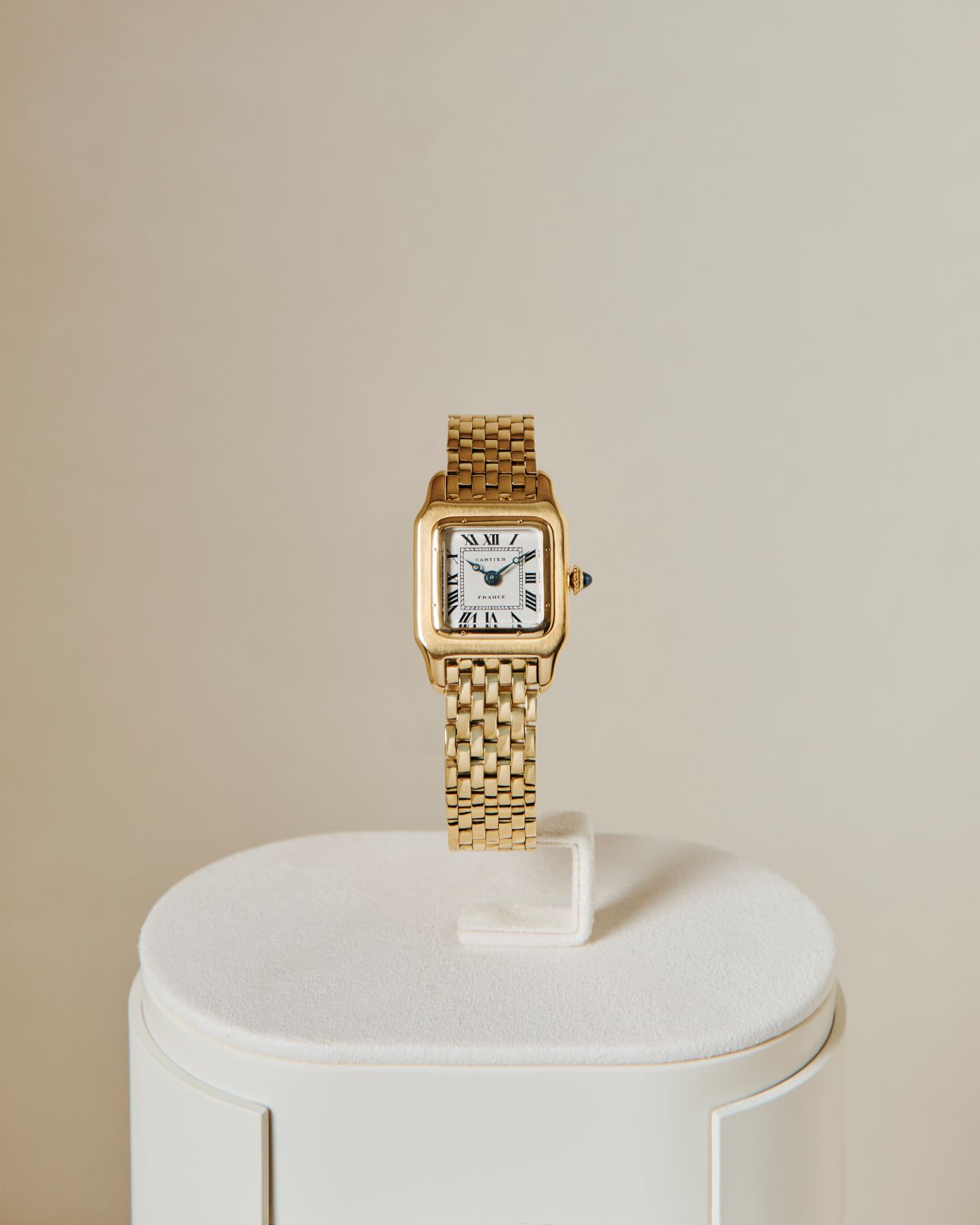
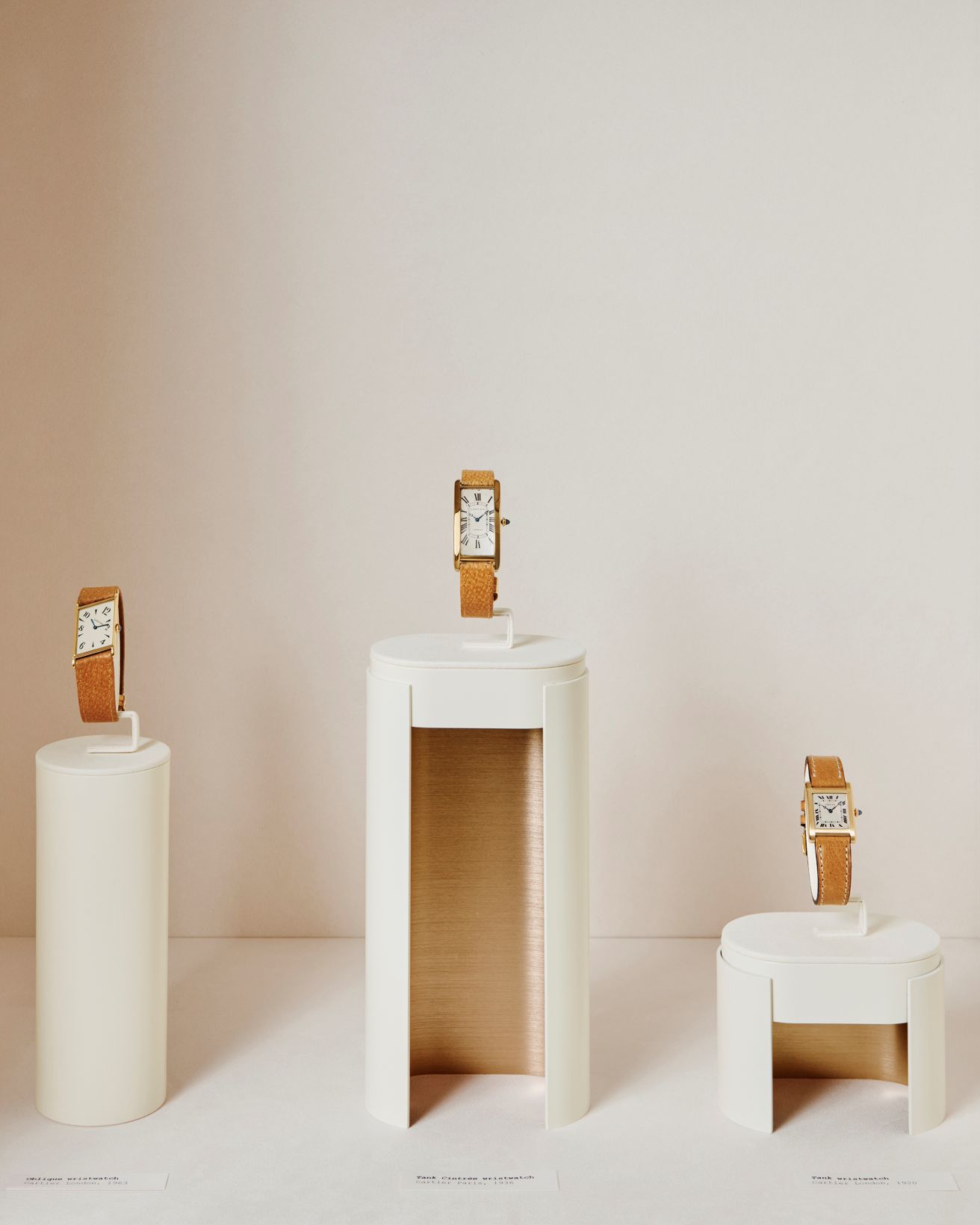
Cartier has transformed its boutique at 35 Rue du Rhône into a showcase celebrating nearly 180 years of watchmaking heritage. Watchmaker of Shapes, Master of Crafts brings together 22 historic timepieces from the Cartier Collection, tracing the Maison’s enduring ties to Switzerland and its distinctive approach to form.
Until November 14, 2026, Cartier is opening the doors of its boutique at 35 Rue du Rhône for Watchmaker of Shapes, Master of Crafts (Victor & Simon - Sophie Tajan)
L’idée est de montrer Cartier comme un horloger des formes et des savoir-faire [...] Nous voulions faire une sélection qui n’avait encore jamais été présentée de cette manière
Pascale Lepeu, directrice de la Collection Cartier
Geneva is far more than a backdrop for Cartier’s latest watch exhibition: it is part of the story. Until November 14, 2026, Cartier is opening the doors of its boutique at 35 Rue du Rhône for Watchmaker of Shapes, Master of Crafts, an intimate exhibition devoted to the Maison’s watchmaking identity and its historic ties to Switzerland.
Created to coincide with the 10th edition of Cartier Privé, the exhibition brings together 22 historic watches spanning more than a century of creativity, from the early 20th century through the 2010s.
Newsletters
Cet article vous plaît ?
Inscrivez-vous à nos newsletters pour recevoir les dernières publications et analyses selon nos 4 thématiques:
NewsGen ZAnalysesTrends to watch
When Form Becomes a Language
At Cartier, the story of a watch often begins before its movement. It begins with a shape. The Tank, Tortue, Tonneau, Cloche and Crash are not simply cases designed to house a mechanism: they are signatures. Over the decades, the Maison has transformed geometry into an instantly recognisable creative vocabulary, making design one of its most powerful means of expression.
On the left, a 1926 Santos wristwatch in yellow and rose gold. On the right, three Tank models, including a particularly rare piece: one of the very first Tanks, a model produced by Cartier as early as 1919 (Victor & Simon - Sophie Tajan)
The exhibition’s scenography echoes this philosophy. Brushed gold, warm wood tones, curved silhouettes and carefully controlled lighting create an environment inspired by Cartier’s watchmaking aesthetic. Inside, visitors discover timepieces that illustrate how design, craftsmanship and technical innovation have continually converged around a single idea: creating a distinctive form.
This is perhaps one of Cartier’s most fascinating paradoxes. The Maison is both a jeweller and a watchmaker, and its watches exist precisely at the intersection of these two disciplines. At Cartier, beauty is not added to technique; the two are conceived together.
Pascale Lepeu, Director of the Cartier Collection, describes the exhibition as a journey through the Maison’s principal forms. “The idea is to show Cartier as a watchmaker of shapes and crafts,” she explains. “We wanted to make a selection that had never been presented in this way before.” From the Santos and Tank to the Tonneau, Tortue and Crash, the exhibition explores some of the silhouettes that have defined Cartier’s watchmaking identity.
A Collection Designed to Preserve and Pass On
Pascale Lepeu, Director of the Cartier Collection (Cartier)
My mission is primarily to preserve an extraordinary heritage
Pascale Lepeu, Director of the Cartier Collection
Few people are better placed than Pascale Lepeu to tell this story. Born in Paris and based in Switzerland since the early 1990s, she joined the Cartier Collection in 1993, initially working alongside Eric Nussbaum, its first director and an internationally renowned jewellery expert. She succeeded him as curator in 2003 and has devoted more than three decades to documenting, preserving and enriching the Maison’s heritage.
Her journey began almost by chance. While working for a Geneva advertising agency, she met Eric Nussbaum while working on a catalogue project. “The following year, I saw an advertisement in the newspaper and applied to work for the Cartier Collection,” she recalls. “And that’s how I joined the Cartier Collection.” What followed would become a lifelong mission.
“My mission is primarily to preserve an extraordinary heritage,” says Pascale Lepeu. “Every year, we are fortunate enough to acquire pieces for the Collection — important pieces as well as small objects, watches, jewellery, clocks, cigarette cases and vanity cases. Over the years, this has created an extraordinary and highly diverse heritage.”
Founded in 1983, the Cartier Collection now comprises more than 3,500 creations, ranging from jewellery and watches to precious objects. Its watchmaking holdings alone include around 1,350 watches and clocks, including nearly 1,000 wristwatches. But Pascale Lepeu refuses to view the Collection as a static archive. “It is a living heritage,” she stresses. “It is not intended simply to be displayed, but above all to be shared and to tell the story of Cartier.”
This philosophy has turned the Collection into a resource for museums, researchers, designers and craftspeople around the world. Cartier regularly lends pieces to international exhibitions; since 1989, more than 45 solo exhibitions have been held in renowned museums around the world, while the Collection itself continues to grow.
The Archive Behind the Object
Behind every historic Cartier watch lies another story: that of its documentation, which makes it possible to determine its origins, date of creation and any subsequent transformations with remarkable precision. Cartier’s archives play a crucial role in this work.
“We were fortunate in the 1980s to have people who understood the importance of all these papers and photographs and did not throw them away,” says Pascale Lepeu. The Maison’s commitment to documentation, however, dates back much further. Louis Cartier himself was deeply committed to preserving records related to the Maison’s creations, even duplicating certain documents and photographing all the works.
This documentary memory can fundamentally change the way a watch is understood. It makes it possible to establish its date, verify its original condition and identify subsequent alterations, whether involving replaced stones, signatures or components. “Being able to date our objects precisely adds enormous value,” explains the curator.
The exhibition also bridges Cartier’s past and present through the 10th installment of Cartier Privé (Victor & Simon - Sophie Tajan)
But documentation is not used solely to authenticate pieces. It also makes it possible to reconstruct a creative history. And the story of Cartier, as revealed through its Collection, extends far beyond watchmaking. As Pascale Lepeu points out, the exhibitions also offer an opportunity to discover “the evolution of the decorative arts, the evolution of women and their emancipation.”
The Emotion of Touching the Origins
Being able to date our objects precisely adds enormous value
Pascale Lepeu, Director of the Cartier Collection
Le modèle Tank de 1920 (Marian Gérard, Collection Cartier)
Among the 22 watches presented in Geneva, one holds particular significance for the Collection’s director: a Tank dating from 1920. In its early days, the model was simply known as the Tank. The qualifier “Normale” appeared later, when the emergence of different variations made it necessary to distinguish between models.
For the curator, finding a watch so close to the birth of a model is a unique experience. “The strongest emotion for me is when we manage to find a watch that is as close as possible to its date of creation,” she says. “We have a Tank from 1920, and it is truly one of the very first. It is extremely rare.”
The significance of this piece goes beyond its age. The first Tank watches were introduced at the end of 1919. A watch dating from 1920 therefore sits almost at the very moment of the birth of one of the most influential designs in 20th-century watchmaking. More than a century later, however, its silhouette has lost none of its modernity.
This is one of the central themes of the Geneva exhibition: Cartier’s ability to create forms that belong to their time while seemingly transcending it.
De Cartier Privé vers le futur
Crash Wristwatch, 1990, platinum and rose gold (Victor & Simon - Sophie Tajan)
The exhibition also creates a bridge between Cartier’s past and present through the 10th edition of Cartier Privé. Launched in 2015, the Cartier Privé collection was conceived as a laboratory for revisiting some of the Maison’s most iconic creations. Over the past decade, it has explored the Crash, Tank Cintrée, Tonneau, Tank Asymétrique, Cloche, Tank Chinoise, Tank Normale, Tortue and Tank à Guichets.
For its 10th edition, Cartier returns to three of these iconic forms: the Tank Normale, Tortue Monopusher Chronograph and Crash Skeleton. All three are crafted in platinum, a material deeply associated with Cartier’s history, and accented with the Maison’s characteristic burgundy details.
Platinum is not simply a contemporary aesthetic choice. It is part of Cartier’s historical DNA, particularly in the early 20th century, when the Maison helped establish platinum as an emblematic material of modern jewellery.
A Heritage That Belongs to the Future
Pascale Lepeu explains that the most rewarding part of her profession may not be acquiring rare pieces, but finding ways to pass them on. “It does not belong to us,” she says of the Collection. “We are here to pass on this living heritage to future generations.”
This idea gives Watchmaker of Shapes, Master of Crafts a particular resonance in Geneva. The watches on display are historic objects, but they are not presented as relics. Instead, they become witnesses to an ongoing creative dialogue.
“All these models were created more than 100 years ago and we are still wearing them today. That is truly extraordinary.”
Perhaps this is the most accurate definition of Cartier’s relationship with time. The Maison does not merely measure it; it gives it a shape. Timeless.
Visitors can register for the exhibition on Cartier’s website.
In Geneva, on the first day of Watches and Wonders, Cartier highlighted an increasingly difficult balance to strike in the industry: fueling desirability for its iconic timepieces while ensuring that its offerings remain affordable for a broader clientele. Louis Ferla, CEO of Cartier, and Arnaud Carrez, Senior Vice President and Chief Marketing Officer of Cartier outline the company’s strategies.
The 82nd edition of the Venice International Film Festival shone through its engaged selection, exemplified by the Silver Lion awarded to Kaouther Ben Hania (The Voice of Hind Rajab). For jeweler Cartier, now a partner for the fifth consecutive year, the festival offers a dream stage: to defend freedom and the universality of creative languages. And to anchor its aesthetic ideal deep in the collective unconscious.